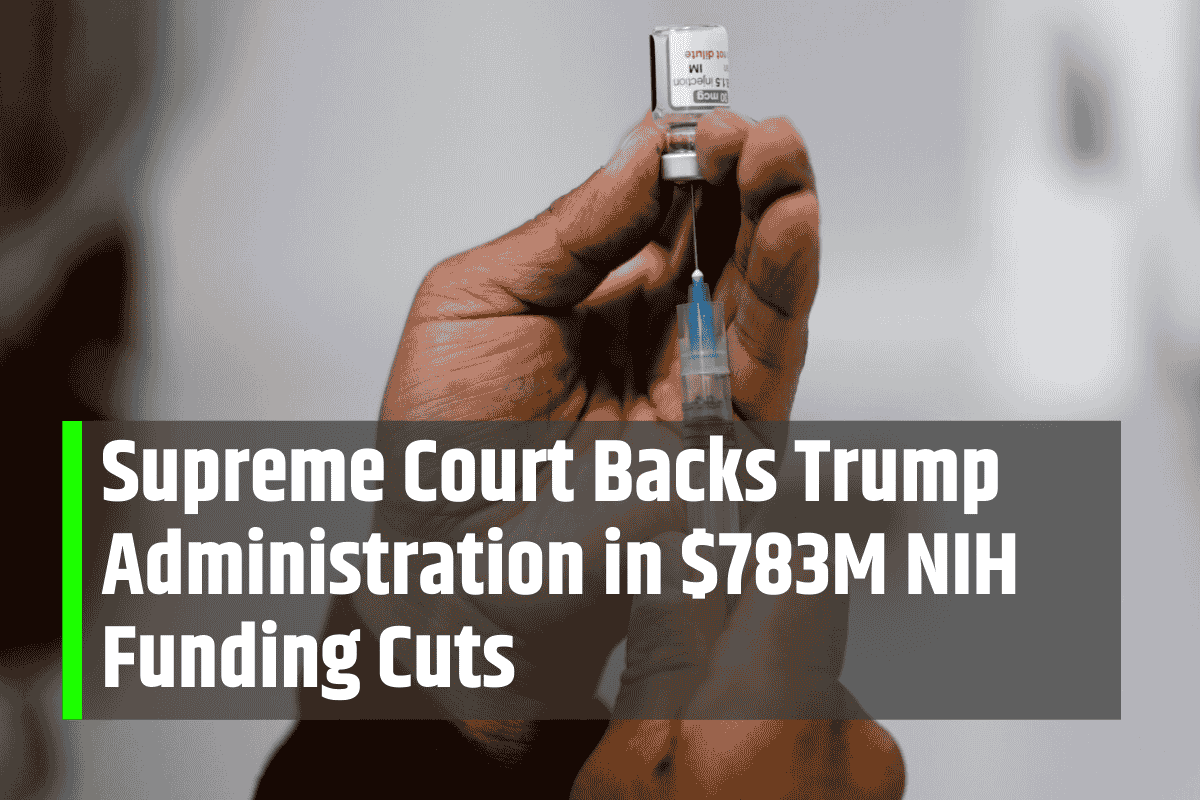
The U.S. Supreme Court has ruled that the Trump administration may cancel $783 million in National Institutes of Health (NIH) research funding tied to diversity, equity, inclusion (DEI), gender identity, and COVID-19-related studies.
The decision represents another major judicial victory for the administration’s policy agenda.
The Court’s Ruling
In a 5–4 decision on August 21, the Court lifted a lower court’s injunction that had temporarily blocked the cuts. Chief Justice John Roberts joined the Court’s three liberals in dissent, saying the funds should remain in place until ongoing legal disputes were resolved.
Jurisdictional Dispute
The majority agreed with the Trump administration’s position that challenges to terminated grants must be heard in the Court of Federal Claims, which handles government contract disputes, rather than in district court.
This jurisdictional ruling allows the administration to proceed with its cuts immediately, even as lawsuits continue.
Lower Court’s Findings
Earlier in June, U.S. District Judge William Young of Massachusetts ruled against the administration, calling the NIH cancellations “breathtakingly arbitrary and capricious.”
He also said the terminations were driven by “racial discrimination and discrimination against America’s LGBTQ community,” adding that the record showed unusually clear evidence of bias.
Judge Young’s Criticism
During hearings, Judge Young expressed alarm at what he viewed as ideological targeting. “I’ve never seen a record where racial discrimination is so palpable,” he stated.
He further accused the administration of deliberately cutting research benefiting LGBTQ Americans, calling the moves “appalling.”
Administration’s Argument
The administration insisted that Young lacked jurisdiction to block the cuts. Solicitor General John Sauer told the Supreme Court that terminating the grants reflected “quintessential policy judgments on hotly contested issues that should not be subject to judicial second-guessing.”
Sauer argued that DEI initiatives often mask unlawful discrimination.
Comparison to Teacher-Training Grants
The administration pointed to a similar case from April, when the Supreme Court allowed the Education Department to terminate millions in teacher-training grants linked to DEI goals.
Justice Department lawyers argued that the NIH case should be handled in the same way, reinforcing executive discretion over federal spending priorities.
Public Health Concerns
Opponents of the cuts, including the American Public Health Association (APHA), warned that halting the grants would disrupt critical medical research.
They argued that canceling studies on Alzheimer’s disease, heart disease in rural communities, and antibiotic resistance could cause “incalculable losses in public health” and weaken global scientific progress.
NIH’s Role in Research
The NIH is the primary source of federal biomedical research funding in the United States and the largest public funder worldwide.
While the $783 million at issue represents only a portion of its overall budget, scientists warn that politically motivated cuts threaten research independence and long-term health innovation.
Scientists’ Response
In June, dozens of NIH researchers and employees signed an open letter condemning the administration’s actions. They said the cuts politicize science, undermine global collaboration, and jeopardize lives.
The letter emphasized that biomedical research should remain nonpartisan, focused on improving health outcomes rather than serving ideological priorities.
Broader Policy Context
The funding cuts are part of President Trump’s broader effort to roll back federal support for DEI and what the administration calls “gender ideology.”
By aligning research funding with conservative policy goals, the administration seeks to reshape federal priorities while reducing spending on initiatives it opposes.
The Supreme Court’s ruling permits the Trump administration to move forward with its NIH funding cuts while legal challenges continue.
Supporters view the decision as a defense of executive authority, while critics warn of devastating consequences for medical research and public health. The case underscores the growing clash between science and politics.