Brexucabtagene autoleucel (brexu-cel) is an FDA-approved chimeric antigen receptor T (CAR T) cell therapy for adults with relapsed or refractory (R/R) B-cell acute lymphoblastic leukemia (B-ALL).
This retrospective study investigates the influence of social determinants of health (SDoH) on the outcomes of adults with B-ALL receiving brexu-cel between 2021 and 2023.
Study Overview
The study analyzed data from 189 patients aged 18 and older with R/R B-ALL treated with brexu-cel. We assessed how race, ethnicity, and SDoH factors like insurance type, referral source, and distance from treatment centers impacted progression-free survival (PFS) and overall survival (OS).
Patient Demographics and SDoH Factors
Of the 189 patients, 57% were male, with the majority identifying as non-Hispanic White (55%), followed by Hispanic (30%), non-Hispanic Black (7%), Asian/Pacific Islander (6%), and other/unknown (2%).
Patients were referred from private/community-based practices (43%) and academic oncology centers (41%). Notably, 35% of patients lived over 50 miles from the CAR T center. Insurance coverage was mostly public (47%) and private (41%).
Social Deprivation Index (SDI)
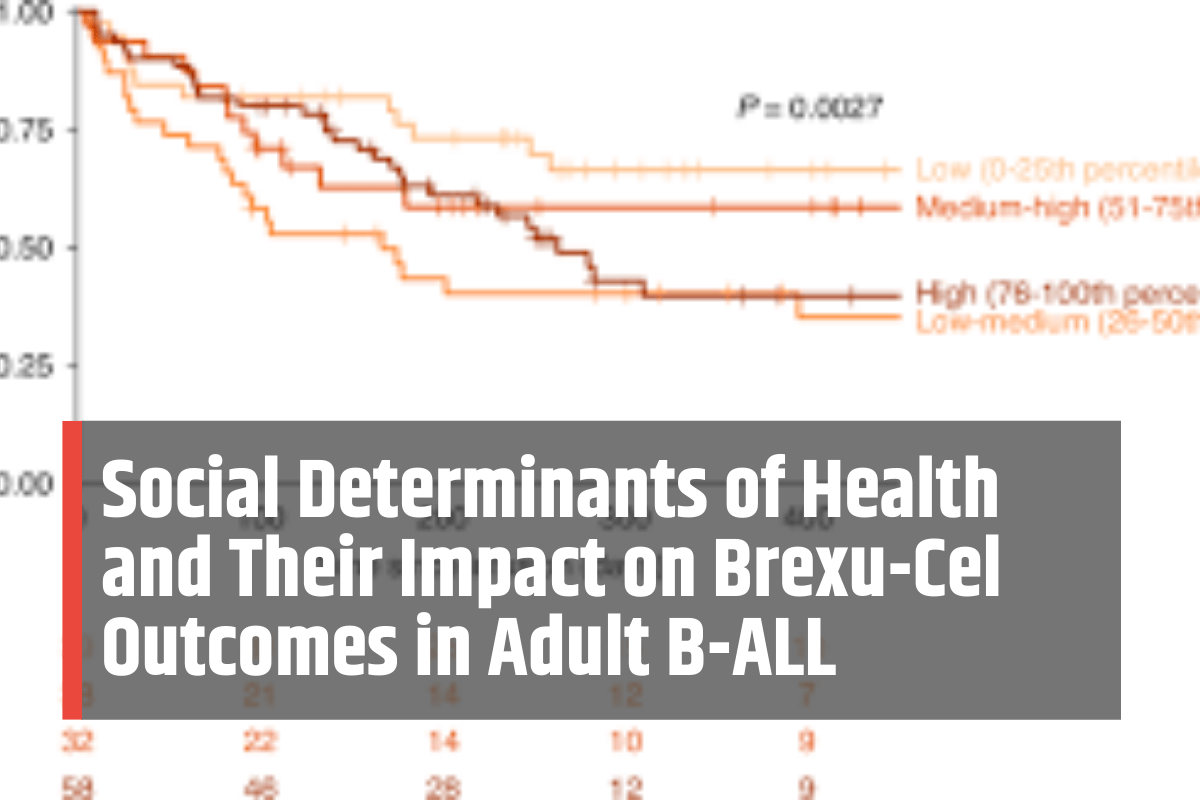
The Social Deprivation Index (SDI), which measures socio-economic disadvantage, was divided into quartiles: low (0–25th percentile), low-medium (26–50th percentile), medium-high (51–75th percentile), and high (76–99th percentile).
Approximately 31% of patients had a high SDI, indicating greater socio-economic disadvantage.
Impact of Race and Ethnicity on Survival
Race and ethnicity were found to have a significant impact on OS, particularly for Black patients. Black patients experienced worse OS (HR 3.48; 95% CI 1.01–12.03) compared to their non-Hispanic White counterparts.
There was no significant difference in PFS for Black or Hispanic patients (HR 1.03, 95% CI 0.50–2.10), suggesting that racial disparities in survival may be more pronounced in overall survival rather than disease progression.
No Impact of SDoH on OS
Despite the presence of various SDoH factors, our study found that SDoH did not significantly impact OS. Although 31% of patients had a high SDI, which indicates higher social deprivation, it did not appear to correlate with survival outcomes.
This finding suggests that access to CAR T therapy may provide equitable outcomes, irrespective of socio-economic background.
Data Analysis Methodology
Cox proportional hazards models were used to evaluate the relationship between race, ethnicity, and SDoH with PFS and OS. Kaplan-Meier unadjusted curves for PFS and OS were constructed, and the analysis utilized SAS Version 9.4.
A chi-squared test compared toxicity outcomes. The results were censored at the time of the last follow-up.
Research Grants and Health Insurance
Health insurance status was considered as part of the SDoH analysis. Public insurance was the most common (47%), followed by private insurance (41%).
While health insurance status can often be a significant factor in treatment accessibility, no direct correlation with survival outcomes was observed in this study, suggesting that insurance coverage did not significantly affect brexu-cel outcomes.
Implications for Future Research
This analysis highlights the importance of considering racial and ethnic disparities in cancer treatment outcomes.
While Black patients in this cohort experienced poorer OS, SDoH factors, including income, insurance, and geographic location, did not appear to significantly impact outcomes.
This suggests that, at least for CAR T therapy, factors like treatment accessibility and health insurance status do not independently explain survival disparities.
Future studies should explore why Black patients in particular experience worse OS, despite similar PFS, and whether genetic, biological, or treatment-related factors may contribute to this disparity.
A Step Toward Equitable Treatment
Brexu-cel therapy offers promising outcomes for patients with R/R B-ALL, with survival rates improving across all racial and ethnic groups. However, racial disparities in OS, particularly for Black patients, remain a challenge.
The lack of significant findings related to SDoH suggests that CAR T therapy may provide equitable treatment outcomes, but further efforts are needed to understand and address the underlying factors contributing to survival disparities.