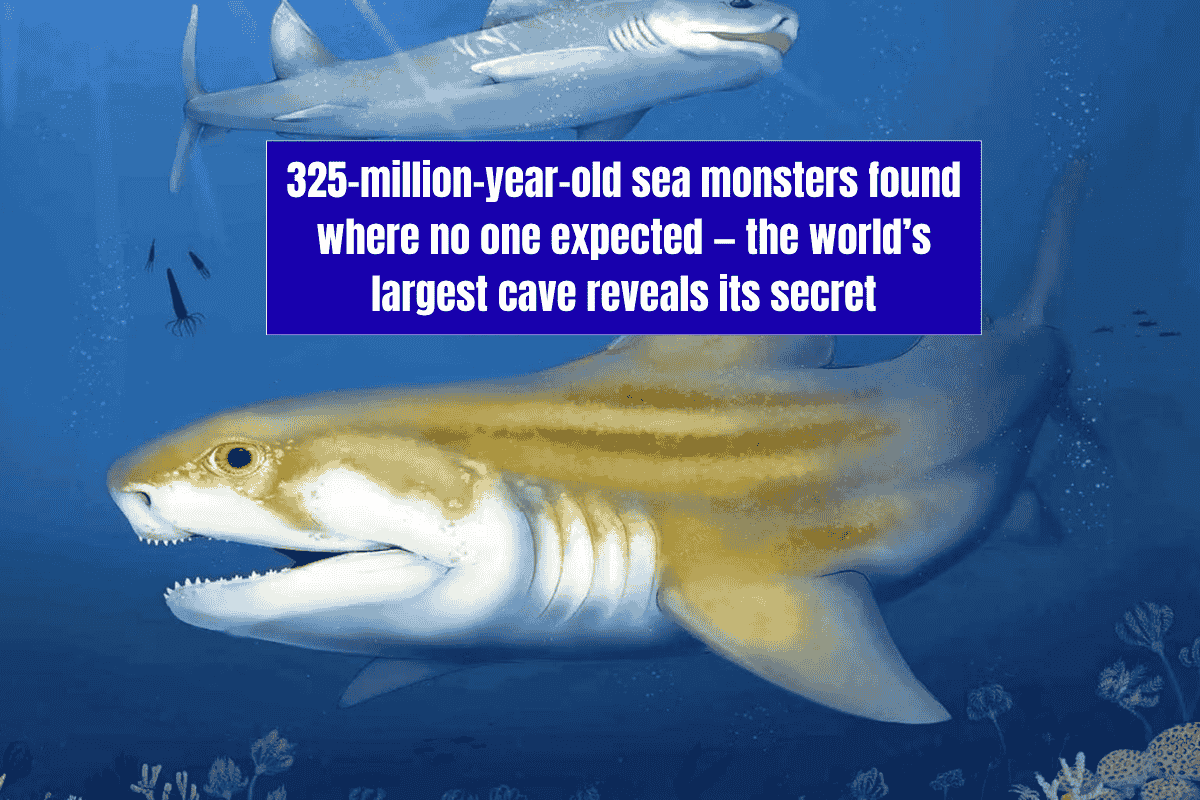
Hidden for over 325 million years, the fossilized remains of two prehistoric sea monsters have been uncovered in Mammoth Cave, Kentucky—the world’s largest cave system spanning more than 260 miles underground. These ancient sharks once prowled the shallow seas that covered eastern North America, revealing a lost oceanic world preserved in limestone.
How Were Prehistoric Sharks Found in Limestone Deposits?
The fossils belong to two species: Troglocladodus trimblei and Glikmanius careforum, both part of the ctenacanth group of sharks. Each measured around 10–12 feet long—similar in size to today’s oceanic whitetip shark.
The remains were discovered in limestone layers from the Middle to Late Mississippian Period (~325 million years ago). Remarkably, some cartilage from Glikmanius careforum was preserved—an extremely rare occurrence, since cartilage usually decays. Protected within cave chambers, these remains provide rare insights into ancient shark anatomy and evolution.
How Did Teams Work Together to Reveal These Fossils?
The discovery was the result of collaborative work between the National Park Service paleontology experts and volunteers from the Cave Research Foundation. Together, they mapped narrow passages, carefully extracted fragile specimens, and preserved them for study.
The naming of Glikmanius careforum honors the Cave Research Foundation’s contributions. Superintendent Barclay Trimble noted that the discovery began with a single Troglocladodus trimblei tooth found in 2019, which led to years of exploration and analysis.
What Do These Sharks Reveal About Ancient Marine Life?
These sharks lived in shallow, warm seas that covered parts of modern Kentucky and Alabama.
- Troglocladodus trimblei had uniquely branched teeth, ideal for catching prey.
- Glikmanius careforum wielded a powerful bite, likely feeding on fish and squid-like orthocones.
Studying these fossils helps scientists track how seas rose and fell, and how marine ecosystems adapted as continents shifted toward forming Pangea.
Why Are These Discoveries Important for Shark Evolution?
The Mammoth Cave fossils add critical pieces to the timeline of shark evolution. By comparing them with fossil records worldwide, scientists can better understand how sharks adapted and survived across mass climate and ecological shifts.
Together with evidence from coral reefs, bony fish, and other marine fossils, these finds reveal how ancient oceans supported complex ecosystems long before the rise of mammals and dinosaurs.
FAQ
Q: How old are the shark fossils found in Mammoth Cave?
A: About 325 million years old, from the Mississippian Period.
Q: What species were discovered?
A: Troglocladodus trimblei and Glikmanius careforum, both ctenacanth sharks.
Q: Why is the cartilage discovery significant?
A: Cartilage rarely fossilizes, so its preservation offers exceptional insights into ancient shark biology.
Q: Who discovered the fossils?
A: Teams from the National Park Service and the Cave Research Foundation, working collaboratively.
Q: What do these findings tell us about Earth’s past?
A: They reveal that Kentucky was once covered by shallow seas, and help us understand how marine life evolved as continents shifted and climates changed.