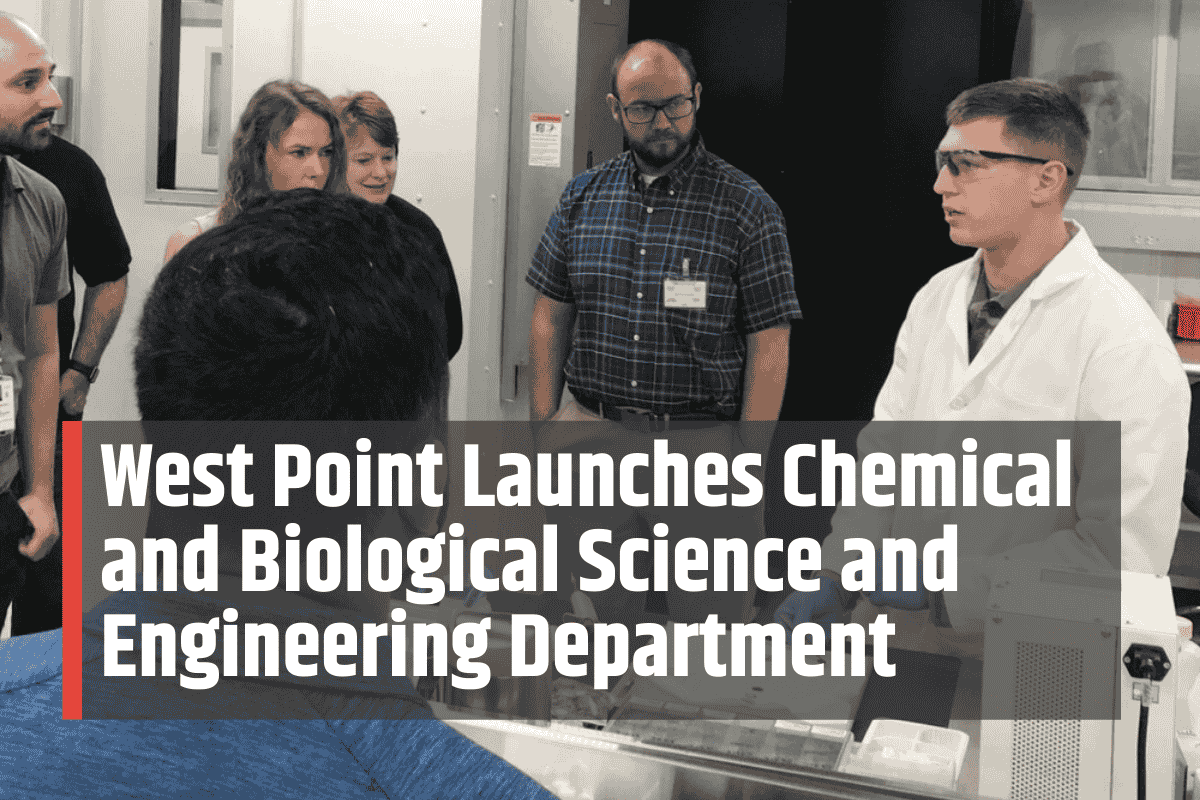
To address the Army’s growing scientific and technical needs, the U.S. Military Academy at West Point has restructured its Department of Chemistry and Life Science.
The new Department of Chemical and Biological Science and Engineering (CBSE) will focus on biotechnology, chemical defense, and medical readiness in support of future warfighting.
Preparing Leaders for Modern Warfare
Brig. Gen. Shane Reeves, Dean of the Academic Board, emphasized that the transformation reflects West Point’s commitment to evolving with military demands.
“We are continuously refining our programs to best prepare cadets to lead on the modern battlefield,” Reeves said, highlighting the Army’s transformation initiative as the guiding framework.
Building on a Strong Legacy
The establishment of CBSE builds on more than 200 years of chemistry instruction and two decades of chemical engineering education.
By integrating modern life sciences and engineering disciplines, the new department ensures cadets are trained in cutting-edge fields directly relevant to Army operations and soldier resilience.
Introduction of New Academic Pathways
As part of this transformation, West Point recently launched a bioengineering minor. The first cadet completed this program with the Class of 2025.
In parallel, the life science major was restructured into a biology major, with its first cohort of graduates expected in 2026. These changes provide foundational academic momentum.
Focus on the Soldier as a System
The biology major is centered on the Army’s most vital system—the soldier. Cadets study human health, performance, and resilience, examining biological systems in relation to mission success.
Coursework emphasizes physiology, disease, and environmental interactions, preparing future officers to understand and protect the force’s health in complex conditions.
Hands-On Research Opportunities
Research is an essential component of cadet training. Biology students collaborate with military laboratories to study infectious diseases, biotechnology, and resilience under stress.
These partnerships expose cadets to real-world challenges and enable them to contribute directly to innovations that enhance soldier readiness and mission performance.
Advancing Bioengineering Education
The bioengineering minor bridges biology and engineering to solve pressing medical and technical problems. Cadets explore the development of medical devices, regenerative biomaterials, and therapeutic strategies.
This training equips them to innovate in areas such as battlefield medicine, advanced treatments, and new technologies that strengthen warfighter survivability and lethality.
Supporting Military Medical Careers
CBSE also oversees the West Point Pre-Medical School Scholarship Program. Through intensive coursework in biology, chemistry, and anatomy, cadets prepare for careers as military physicians.
This pathway helps the Army maintain a pipeline of highly trained medical professionals capable of addressing complex health and combat readiness challenges.
Innovation Beyond the Battlefield
While directly supporting Army priorities, CBSE’s work extends into broader scientific domains. Faculty and cadets investigate areas like energy storage, chemical engineering solutions, and medical innovations.
These advances not only benefit warfighters but also have potential applications in civilian medicine, energy sustainability, and national security.
Aligning with Army Modernization
The creation of CBSE is part of West Point’s wider academic modernization plan. The Army seeks to eliminate outdated programs and reallocate resources toward emerging technologies.
By investing in fields like biotechnology and chemical defense, the Academy ensures its graduates remain prepared for the rapidly evolving character of war.
CBSE represents more than a name change—it is a strategic investment in future leaders. By integrating chemical, biological, and engineering sciences, the department equips cadets with the knowledge and skills to confront challenges in soldier health, readiness, and technological innovation. West Point continues to modernize to meet the Army’s future needs.