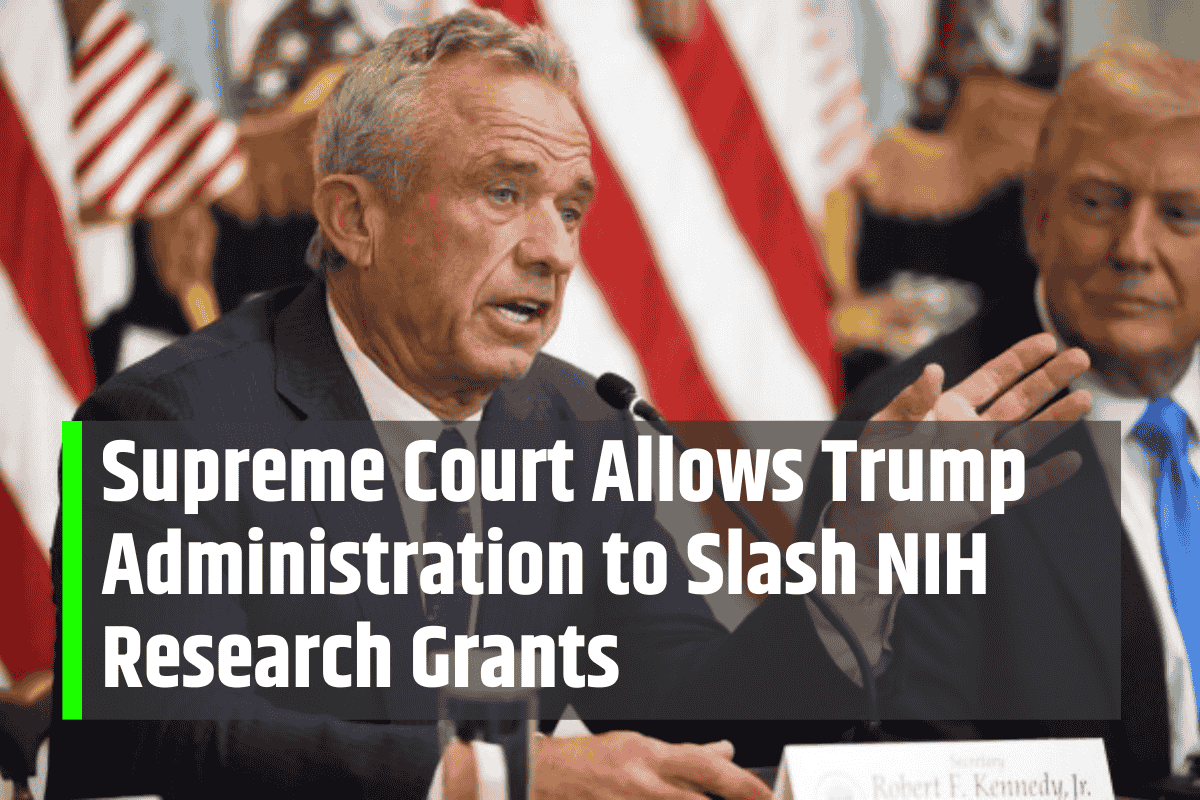
The U.S. Supreme Court has ruled in favor of the Trump administration, allowing it to cut nearly $800 million in federal research funding.
The 5–4 decision permits the National Institutes of Health (NIH) to cancel hundreds of grants as part of a broader effort to dismantle federal diversity, equity, and inclusion (DEI) programs.
Details of the Ruling
In a decision issued Thursday, the justices lifted a lower court order that had temporarily blocked $783 million in grant terminations.
The ruling came in response to a request from the Justice Department, which argued that requiring NIH to continue paying for the contested grants undermined executive authority.
Lower Court Challenge
The ruling overturns an earlier decision by U.S. District Judge William Young of Boston, who in June blocked the cuts. Young ruled that the grant cancellations violated federal law and were “breathtakingly arbitrary and capricious.”
That challenge, brought by researchers, advocacy groups, and 16 states, will continue in lower courts.
Scope of the Cuts
The NIH, the world’s largest funder of biomedical research, had ordered staff to terminate projects deemed inconsistent with Trump administration priorities.
Affected areas include breast cancer, Alzheimer’s disease, suicide prevention, HIV research, depression studies, and training programs aimed at supporting diverse groups of scientists in biomedical research.
Impact on Public Health
Plaintiffs argue that the cuts will inflict “incalculable losses in public health and human life.” Many of the targeted studies address diseases disproportionately affecting minority communities, including HIV and breast cancer.
Public health organizations warn that halting this research will delay critical advancements and widen existing health disparities.
Administration’s Rationale
The Trump administration defended the cuts as part of its mission to “align spending with priorities.” After Trump signed executive orders in January targeting DEI and “gender ideology,” NIH moved quickly to eliminate projects it described as “low-value and off-mission.”
This included studies on vaccine hesitancy and COVID-19-related behavior.
Judge Young’s Rebuke
During a June hearing, Judge Young condemned the administration’s actions, suggesting they were motivated by discrimination. “I’ve never seen a record where racial discrimination was so palpable,” he said.
Young added that the cuts specifically targeted health research for LGBTQ Americans, calling the actions “appalling” and ideologically driven.
Broader Conservative Majority
The Supreme Court’s 5–4 ruling highlights its conservative tilt. With a 6–3 conservative majority, the Court has repeatedly sided with the Trump administration since his return to office in January.
Thursday’s decision follows a similar ruling in April, when the Court allowed cuts to DEI-focused teacher training grants.
Legal Arguments
The administration also argued that the lawsuits were filed in the wrong court. Officials claimed the case should have been brought before the Court of Federal Claims, which specializes in monetary disputes against the federal government.
The Supreme Court accepted this reasoning in the earlier teacher training case.
Reaction from Advocacy Groups
Public health advocates have decried the ruling as a dangerous precedent. The American Public Health Association, a plaintiff in the case, called the cancellations “an ongoing ideological purge.”
Researchers say the decision undermines scientific independence and sets back decades of progress on pressing health challenges.
States Join the Fight
Sixteen states, most led by Democratic governors, are also plaintiffs in the case. They argue that the cuts not only endanger public health but also violate Congressional mandates requiring NIH to support diverse participation in research.
States warn the decision could destabilize local health systems reliant on federal research funding.
By lifting the block on nearly $800 million in NIH funding cuts, the Supreme Court has given the Trump administration a significant victory in its campaign against DEI programs.
While litigation continues in lower courts, the ruling permits immediate cancellation of hundreds of research projects, sparking concerns over health equity and scientific progress.