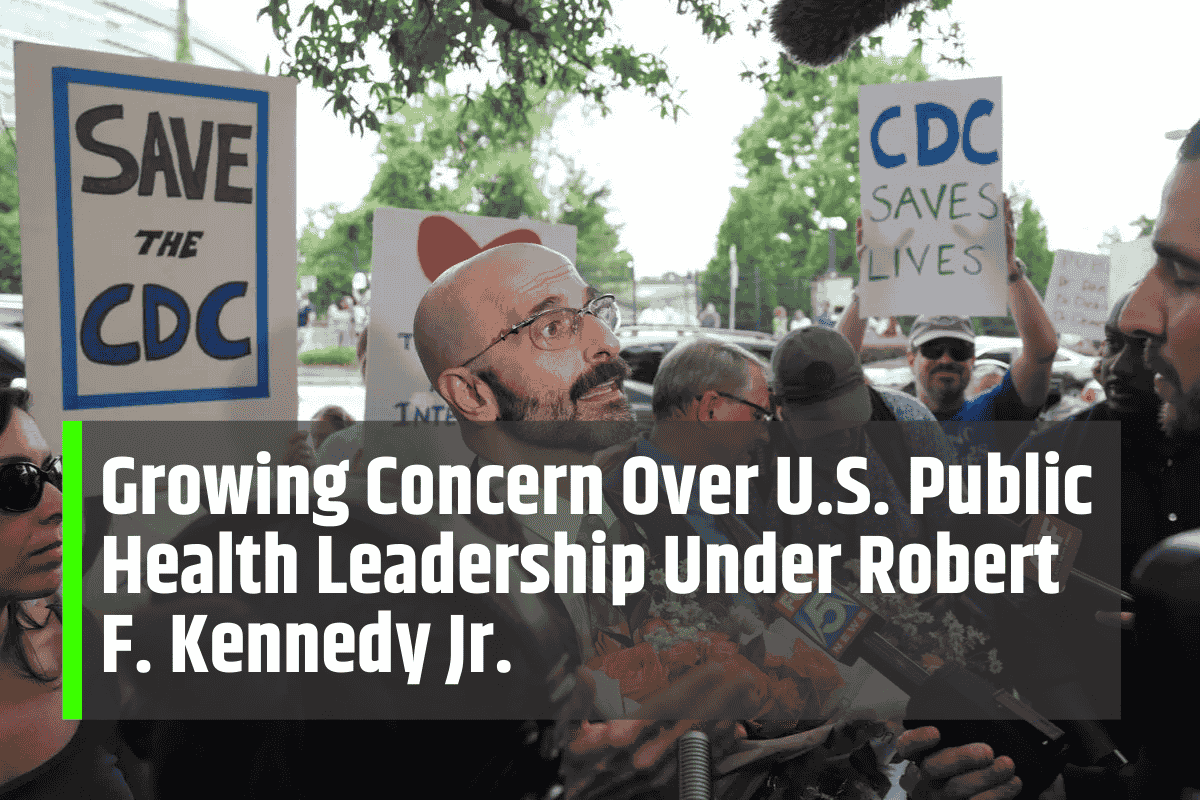
Former CDC immunizations director, Demetre Daskalakis, has sounded the alarm over the future of American public health under the leadership of Robert F. Kennedy Jr., the newly appointed Secretary of Health and Human Services.
Daskalakis, who resigned from his position in protest of the White House’s firing of CDC Director Susan Monarez, expressed grave concerns about the direction of U.S. health policy, particularly regarding vaccine practices.
Daskalakis’ Warning on Harmful Direction
In an interview with ABC on Sunday, Daskalakis explained his resignation, stating that he saw no future under the current leadership that aligned with the Hippocratic Oath he took as a doctor.
He expressed concerns over ideological influence in public health decisions, particularly the recent reshaping of the Advisory Committee on Immunization Practices (ACIP).
He noted that the committee’s new direction seemed aimed at undoing vaccination programs, which could lead to significant harm.
“I only see harm coming,” Daskalakis warned. He emphasized that the committee’s shift towards ideology could undermine years of progress made in promoting vaccination as a cornerstone of public health in the U.S.
Political Interference and the Breakdown of Scientific Independence
Daskalakis also criticized the political interference that had led to the firing of Monarez, which came amid deep budget cuts to the CDC and increasing political pressure on the agency.
He described how the firewall between science and ideology at the CDC had been completely broken down, making it impossible for the agency to operate as an independent body that prioritized scientific evidence over political agendas.
According to Daskalakis, this breakdown would ultimately hinder the CDC’s ability to address public health effectively.
Changes to COVID-19 Vaccine Policy Spark Concern
A significant point of contention has been Kennedy’s recent decision to change the childhood COVID-19 vaccination schedule. Under the new guidance, the vaccine is currently recommended only for individuals 65 and older, and for those with underlying health conditions.
However, Daskalakis pointed out that data does not support this recommendation, particularly for young children. He noted that many children, without underlying conditions, were hospitalized due to COVID-19 last season, further supporting the need for vaccination in younger age groups.
“The data say that in that age range, you should be vaccinating your child,” Daskalakis stated. He warned that limiting access to vaccines in this manner could make it harder for families to get their children vaccinated, potentially causing further public health risks.
Doubts About New CDC Leadership
Daskalakis also expressed doubt over the leadership of Jim O’Neill, the newly appointed CDC chief, who previously worked closely with Kennedy. O’Neill, lacking a background in medicine or infectious disease science, raised concerns about his ability to lead the CDC effectively.
Daskalakis specifically questioned O’Neill’s trustworthiness after a controversial post on X (formerly Twitter) where O’Neill claimed that CDC scientists had manipulated data to align with an ideological agenda. This further fueled Daskalakis’s belief that O’Neill’s leadership would serve Kennedy’s anti-vaccine agenda rather than public health.
Calls for Kennedy’s Resignation
Daskalakis’s resignation comes amid mounting criticism from across the political spectrum. Vermont Senator Bernie Sanders has called for Kennedy’s resignation, accusing him of endangering public health with his actions and statements.
Sanders stated in a New York Times op-ed that Kennedy’s leadership was causing harm both now and in the future, as the secretary continued to promote discredited health claims and spread misinformation.
This call for Kennedy’s resignation has been echoed by over 750 current and former employees of U.S. health agencies, who signed a letter denouncing him as an “existential threat” to public health.
The letter accused Kennedy of dismantling the country’s public health infrastructure and spreading harmful misinformation that jeopardizes the health of Americans.
The Impact of Misinformation
The issue of misinformation has become even more pressing in light of a tragic incident at the CDC headquarters in Atlanta, where a gunman influenced by anti-vaccine misinformation tragically shot and killed a police officer before taking his own life.
According to the gunman’s father, the shooter had been misled into believing that the COVID-19 vaccine was making him sick. This incident highlights the dangerous consequences of spreading false health information, and underscores the importance of restoring trust in public health authorities.